Morality and Capitalism: A Dialogue on Freedom by David Kendall
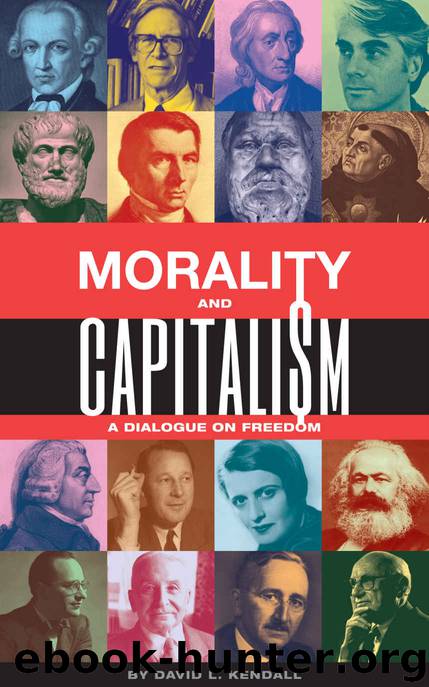
Author:David Kendall [Kendall, David]
Language: eng
Format: epub
Published: 0101-01-01T00:00:00+00:00
Part II: Capitalism
In a capitalist society, all human relationships are voluntary. Men are free to cooperate or not, to deal with one another or not, as their own individual judgments, convictions, and interests dictate. They can deal with one another only in terms of and by means of reason, i.e., by means of discussion, persuasion, and contractual agreement, by voluntary choice to mutual benefit.
Ayn Rand81
Chapter 6. What Is Capitalism?
Capitalism is what people do when you leave them alone.
Kenneth Minogue82
~ ~ ~
Tyro: Solon, I am puzzled.
Solon: That is a good thing, Tyro. Puzzlement is the beginning of wisdom. What is it that puzzles you?
Tyro: Today in school, our history teacher told us that some guy named Karl Marx wrote that capitalism is just a temporary evolutionary stage in human history that empowers the wealthy, exploits the working class, and keeps them poor. He also told us that socialism will eventually replace capitalism.
Solon: Why does that puzzle you, Tyro?
Tyro: Because our teacher also told us that America is a capitalist country. But most people in America are certainly not poor. It seems to me that America is one of the richest countries in the world, and that lots of other countries that are not anything like capitalist countries do have lots of poor people.
Solon: Perhaps your teacher does not know what capitalism really is.
~ ~ ~
Capitalism is a social system of political economy. In the words of Ayn Rand,
[A] social system is a set of moral-political-economic principles embodied in a society’s laws, institutions, and government, which determine the relationships, the terms of association, among the men living in a given geographical area. … Capitalism is a social system based on the recognition of individual rights, including property rights, in which all property is privately owned.83
Milton Friedman, the preeminent Nobel laureate and defender of capitalism, offered the following description of capitalism:
A working model of a society organized through voluntary exchange, is a free private enterprise exchange economy—what we have been calling competitive capitalism.”84
Tens, if not hundreds of writers have proposed definitions and descriptions of capitalism.85 But in the end, the four essential, defining elements of capitalism are private property, voluntary exchange, freedom, and just law. To understand what capitalism is—what it really is and what it is not—we must explore the genesis, meaning, and implications of these four foundational elements of capitalism.
Download
This site does not store any files on its server. We only index and link to content provided by other sites. Please contact the content providers to delete copyright contents if any and email us, we'll remove relevant links or contents immediately.
| Anthropology | Archaeology |
| Philosophy | Politics & Government |
| Social Sciences | Sociology |
| Women's Studies |
The remains of the day by Kazuo Ishiguro(9004)
Tools of Titans by Timothy Ferriss(8403)
Giovanni's Room by James Baldwin(7352)
The Black Swan by Nassim Nicholas Taleb(7137)
Inner Engineering: A Yogi's Guide to Joy by Sadhguru(6799)
The Way of Zen by Alan W. Watts(6621)
The Power of Now: A Guide to Spiritual Enlightenment by Eckhart Tolle(5789)
Asking the Right Questions: A Guide to Critical Thinking by M. Neil Browne & Stuart M. Keeley(5779)
The Six Wives Of Henry VIII (WOMEN IN HISTORY) by Fraser Antonia(5519)
Astrophysics for People in a Hurry by Neil DeGrasse Tyson(5196)
Housekeeping by Marilynne Robinson(4455)
12 Rules for Life by Jordan B. Peterson(4312)
Double Down (Diary of a Wimpy Kid Book 11) by Jeff Kinney(4278)
Ikigai by Héctor García & Francesc Miralles(4278)
The Ethical Slut by Janet W. Hardy(4262)
Skin in the Game by Nassim Nicholas Taleb(4256)
The Art of Happiness by The Dalai Lama(4133)
Skin in the Game: Hidden Asymmetries in Daily Life by Nassim Nicholas Taleb(4012)
Walking by Henry David Thoreau(3968)
